
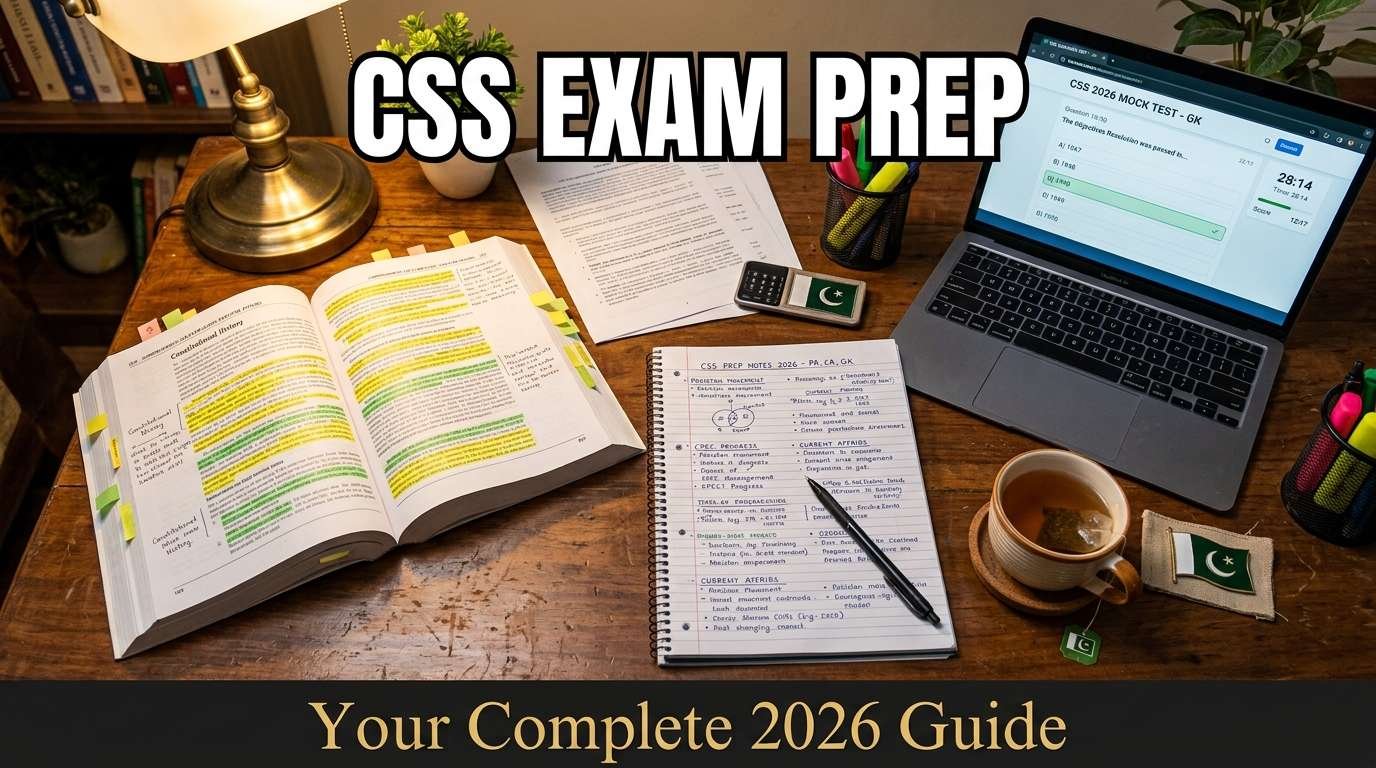
Landing a government job in Pakistan through the Central Superior Services examination requires more than ambition. It demands a structured, disciplined approach to preparation that covers all six compulsory subjects, your selected optional subjects, and the viva voce interview. Candidates who enter the process with a clear study plan consistently outperform those who rely on scattered, unorganized studying.
This guide breaks down the CSS preparation process into actionable steps that you can follow regardless of your educational background or current career situation.
Understanding the CSS Exam Structure
The CSS examination consists of 12 papers spread across compulsory and optional subjects. The six compulsory papers include English Essay, English Precis and Composition, Current Affairs, Pakistan Affairs, Islamic Studies or Comparative Religion, and General Science and Ability.
Candidates then select six optional subjects from a wide range of groups covering humanities, social sciences, pure sciences, and professional subjects. Your choice of optional subjects significantly affects your scoring potential because some subjects have historically higher average marks while others are more competitive.
The total marks for written papers are 1200, and the viva voce interview adds another 300 marks. A candidate typically needs to score above 50% overall with no paper falling below 33% to be considered for the merit list.
Building a Study Timeline
Effective CSS preparation requires a minimum of 8 to 12 months of focused study. Candidates who start earlier have the advantage of deeper revision cycles and more practice paper attempts.
A proven approach divides the preparation into three phases. The first phase, spanning months one through four, focuses on building a strong foundation in all compulsory subjects. During this period, read core textbooks, take detailed notes, and build a current affairs journal that you update weekly.
The second phase, from months five through eight, shifts to optional subjects while maintaining daily revision of compulsory material. This is where most candidates make a critical mistake by neglecting their compulsory subjects while diving into optionals. Consistent daily review of at least two compulsory subjects prevents knowledge decay.
The final phase covering months nine through twelve is pure revision and practice. This period should focus heavily on solving past papers under timed conditions, writing practice essays weekly, and testing yourself with MCQ question banks across all subjects.
Subject-by-Subject Preparation Strategy
English Essay requires regular writing practice. Aim to write at least two complete essays per week covering diverse topics from current affairs to social issues. Focus on developing a clear thesis, logical paragraph transitions, and a strong conclusion. Read quality opinion columns and editorials daily to build your analytical vocabulary naturally.
English Precis and Composition tests technical language skills. Grammar, sentence correction, and comprehension can be improved through consistent practice with past papers. The precis writing component requires the ability to condense passages to one-third their original length while preserving the core message.
Current Affairs is often the highest-scoring compulsory subject for well-prepared candidates. Read one national and one international publication daily. Maintain a categorized notebook covering Pakistan’s relations with major countries, domestic economic indicators, and key international developments.
Pakistan Affairs demands deep knowledge of the country’s history, constitution, economy, and governance structure. Use a combination of textbook study and supplementary reading to build a comprehensive understanding rather than surface-level memorization.
The Role of MCQ Practice in CSS Preparation
The FPSC has increasingly incorporated MCQ-format questions into several CSS papers. General Science and Ability, in particular, relies heavily on objective-type questions testing scientific literacy, mathematical reasoning, and analytical skills.
Regular MCQ practice serves two purposes. First, it exposes you to the breadth of topics the FPSC draws from, helping you identify gaps in your knowledge early. Second, it builds speed and accuracy under time pressure, which directly translates to better performance on exam day.
Platforms like TheCSSBooks offer extensive CSS-focused MCQ banks with over 27,000 questions covering all compulsory and optional subjects. Practicing in test-simulation mode with time limits mirrors the actual exam environment and builds the mental stamina needed for a full day of papers.
Essay Writing Mastery
The English Essay paper is often the difference between qualifying and missing the cut. FPSC essays are evaluated on content depth, argument structure, language quality, and relevance to the chosen topic.
A strong CSS essay follows a predictable structure. Open with a compelling hook that demonstrates awareness of the topic’s significance. Present a clear thesis statement in the first paragraph. Develop three to four body sections with distinct arguments, each supported by specific examples, data, or historical references. Close with a synthesis that ties your arguments together and offers forward-looking insight.
Common mistakes include writing overly long introductions, repeating the same point in different words across paragraphs, and failing to connect examples back to the central thesis. Practice with structured essay outlines before writing full drafts to build organizational discipline.
For pre-built essay frameworks across dozens of CSS-relevant topics, an essay outline generator can help you structure your arguments before you begin writing, saving valuable planning time during practice sessions.
Viva Voce Interview Preparation
Many candidates treat the interview as an afterthought, focusing all energy on the written exams. This is a strategic error. The 300-mark interview represents 20% of your total score and can dramatically shift your merit position.
Interview panels typically include senior bureaucrats and academics who evaluate your confidence, communication clarity, general knowledge breadth, and personality. They often ask about current national and international issues, your motivations for joining civil service, and your understanding of the service group you prefer.
Prepare by conducting mock interviews with peers or mentors who can give honest feedback. Stay updated on the latest government policies, economic indicators, and major national developments in the weeks leading up to your interview date.
Common Preparation Mistakes to Avoid
Relying on a single source for any subject is risky. Different authors emphasize different aspects, and FPSC questions can come from angles that one textbook does not adequately cover. Use at least two sources per subject and supplement with past paper analysis.
Ignoring General Science and Ability because you have a humanities background is another common mistake. This paper carries the same marks as every other compulsory subject, and its MCQ-heavy format actually makes it more scoreable with targeted practice than many candidates assume.
Skipping current affairs during the final revision month is equally dangerous. The FPSC designs questions based on events that occur right up to the exam date. Candidates who stop reading news two months before the exam miss recent developments that frequently appear in the Current Affairs paper.
What Comes After Passing CSS
The ultimate purpose of all this preparation is securing a position in Pakistan’s civil service. Understanding the career paths, BPS grade progressions, and posting patterns that await successful candidates helps maintain motivation during difficult preparation periods.
Government departments and autonomous bodies regularly post new positions for CSS-qualified officers. Staying connected to current government job listings even during your preparation phase keeps you informed about the opportunities that your hard work will eventually unlock.
Whether you aim for the Pakistan Administrative Service, Foreign Service, Police Service, or any other group, the CSS examination remains the most respected and direct pathway into the leadership tier of Pakistan’s public sector.
FAQ
How long should I prepare for the CSS exam?
Effective CSS preparation requires a minimum of 8 to 12 months of focused study. Candidates who start 12 months early have the advantage of deeper revision and more practice paper cycles.
What is the minimum score needed to pass CSS?
Candidates typically need to score above 50% overall across all papers with no individual paper falling below 33%. The exact cutoff varies each year based on the merit list.
How important is the CSS viva voce interview?
The viva voce carries 300 marks out of a total 1500, representing 20% of your score. A strong or weak interview performance can shift your merit position by dozens of places.